
It is a new year, and everyone should look out for their own personal health and happiness at the start of the year. Whenever we start a new year, it is normal to prepare for the year ahead with a positive outlook, renewed purpose and new goals. Health is at the forefront of a lot of people’s minds each new year.
Most people do blood work and urinalysis as a part of the lab work with their yearly physical. These labs are most often how we suspect there may be an underlying kidney injury or disease. Unfortunately, there are a number of ways kidney disease may be easily missed in labs. For example, some general physicians in American are ill-trained and unable to readily catch and treat kidney disease. Additionally, as healthcare becomes more corporatized and physicians and other healthcare providers are forced to see more patients in shorter periods of time, subtle shifts in lab work may be overlooked or missed altogether.
One of the benefits of the modern age is readily available access to our own health care information through patient portals. So, what should we look for? What should we be aware of? How do we prevent End-Stage Renal Disease? The answer is simple: regular labs with your doctor and have those labs reviewed and followed up. Kidney disease is shown through blood work and urinalysis.
What is Chronic Kidney Disease (CKD)?
Chronic kidney disease, or CKD, is a serious condition that involves the gradual loss of kidney function. The kidneys are responsible for filtering your blood to remove waste in the body as well as excess water in order to create urine. Healthy kidneys are capable of filtering about half a cup of blood every minute, but CKD can drastically reduce kidney function.
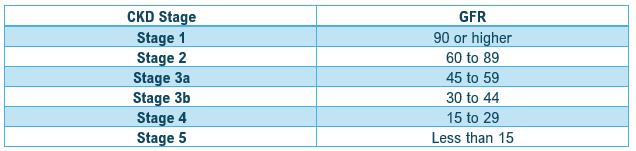
There are five stages of CKD. For most disease processes, your kidneys can still function well in the early stages, but they will lose nearly all function by the time the disease has advanced to the later stages. The last stage of CKD, which is stage 5, is known as end-stage renal disease (ESRD). This stage Is also called kidney failure, since it is characterized by the complete loss of kidney function. If you reach this stage, you will need either dialysis or a transplant in order to survive.
3 Signs of Early-Stage CKD
Early detection is crucial when it comes to CKD. Usually, the sooner you begin treatment, the easier it will be to slow down the progression of CKD.
Obvious signs and symptoms may not appear in the early stages of CKD, which is why its illness often goes undetected until it is in an advanced stage. In fact, the National Institutes of Health (NIH) reports that less than 10% of patients with stages 1 to 3 CKD are aware of their condition. For this reason, CKD is known as a “silent disease”. However, there are clues that lab work reveals:
- Blood and/or Protein in Your Urine
If a urinalysis shows blood and/or protein, this is an early sign of possible CKD.
- Positive ACR Test Results
An albumin-to-creatinine ratio (ACR) test is used to detect protein in your urine, which is a sign that your kidneys are not filtering your blood properly. Ask your doctor to preform this test annually – especially if you are at a high risk of developing kidney disease. If your test results are positive, this could indicate that you have early-stage CKD.
- Abnormal GFR
You should also ask your doctor for a blood test to look for early signs of kidney disease. A blood test will measure the level of creatinine in your blood. Creatinine is a waste product that comes from muscle tissue. Normally, the kidneys remove this product from your blood, so high creatinine levels could indicate kidney damage.
CKD cannot be diagnoses with creatinine levels alone. Instead, your doctor will use a mathematical formula to calculate your glomerular filtration rate (GFR) based on your creatinine levels, age, gender, and race. Your GFR will go down as you progress through the different stages of CKD.
Failing to diagnose or misdiagnosing a patient’s CKD may constitute medical malpractice. Healthcare providers commit medical malpractice when their treatment falls below a “standard of care”. Many malpractice claims arise as a result of failure to diagnose or misdiagnosis, so you may have a case if your CKD was not properly diagnosed.
So, take regular labs with your doctors, make sure you discuss your labs results and follow up if they are any red flags. Patients need to be their own advocates in today’s medicine.